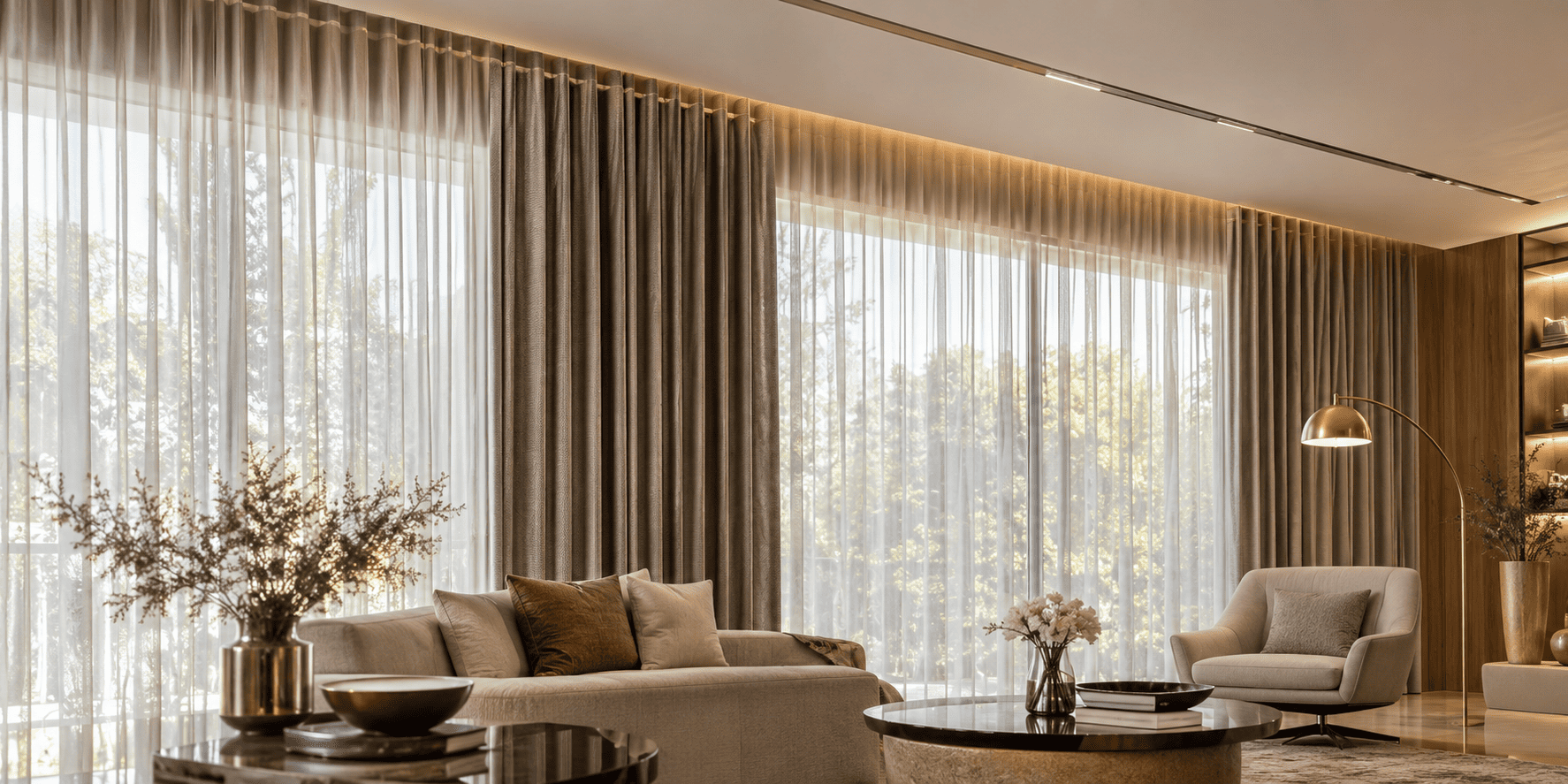
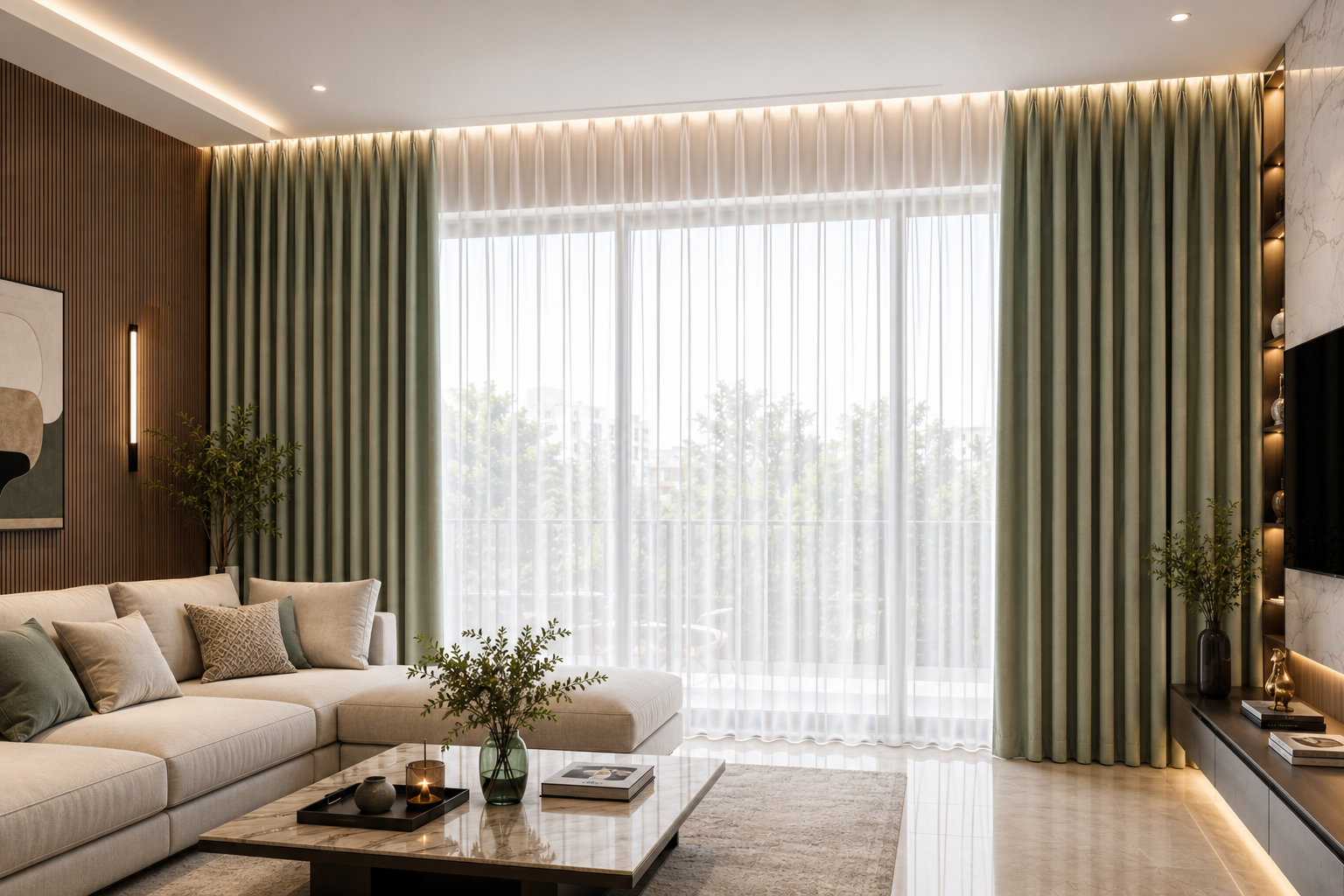
When customers come looking for curtains, one of the most common requests we hear is:
"I want blackout curtains."
But what does “blackout” actually mean?
This is where considerable confusion exists.
Many customers use the word blackout to describe any thick curtain that reduces sunlight. But a thick decorative curtain and a true blackout curtain are not necessarily the same thing.
Then there is dimout, which sits between a normal thick curtain and a blackout solution.
And there are sheer curtains, which serve an entirely different purpose.
Understanding these differences before choosing your curtains can help you avoid disappointment later.
Because when selecting curtains, there is always a balance between light control, privacy, appearance, fabric texture, weight and drape.
The right choice depends on what you want your room to achieve.
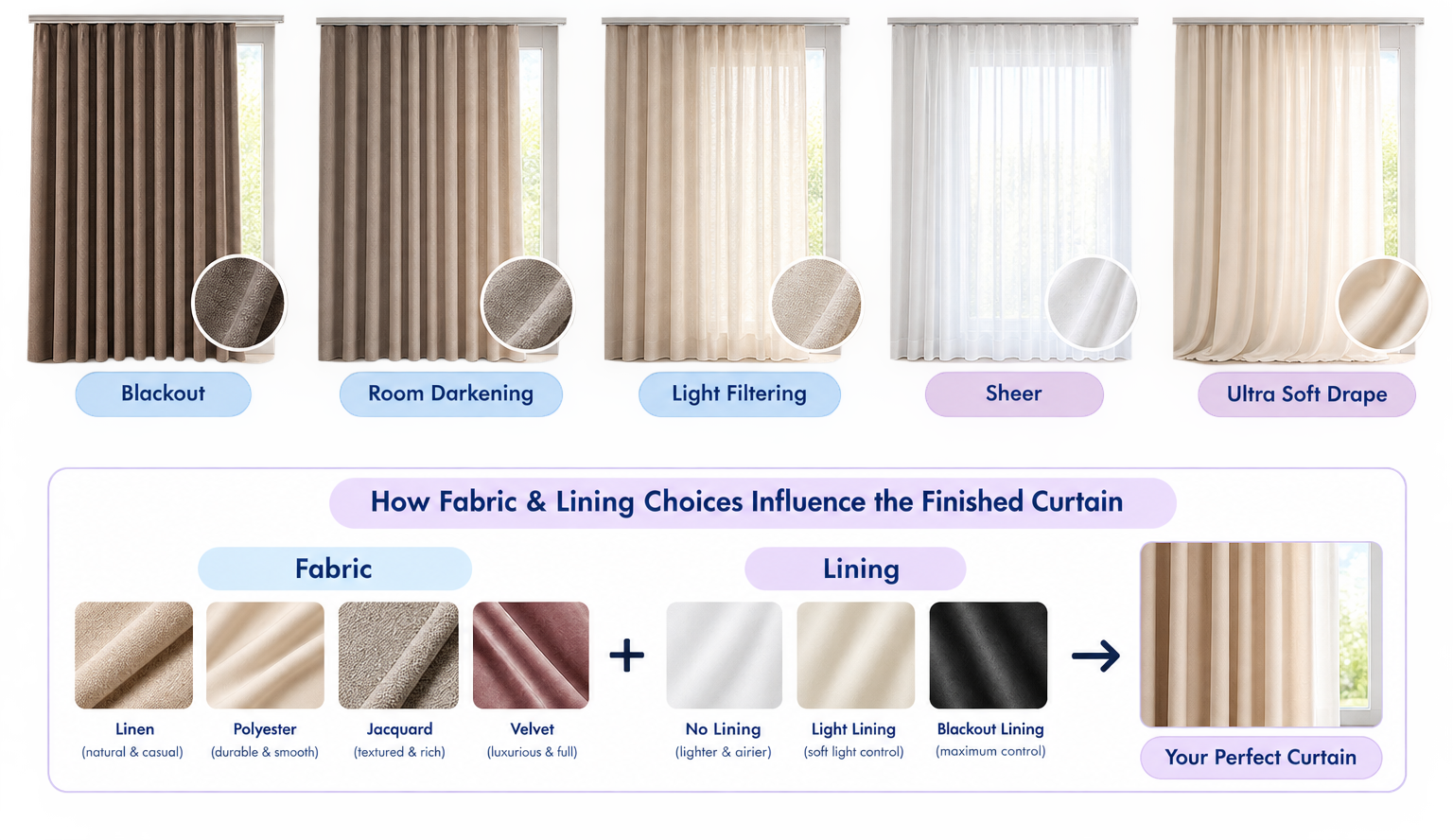
The Four Main Curtain Categories
| Curtain Type | Approximate Light Blockage* | Main Purpose |
|---|---|---|
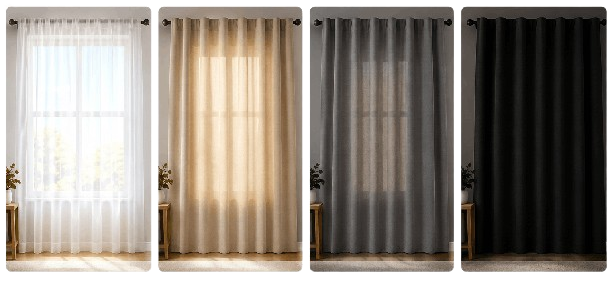
| Sheer | Allows substantial light through | Daylight, softness and daytime privacy |
| Thick Decorative Curtain | Around 70% | Privacy, decoration and light reduction |
| Dimout | Around 80% | Greater light control and privacy |
| Blackout | Up to 100% | Maximum light blocking |
*Light performance varies depending on fabric construction, colour, installation and the complete curtain system. The percentages above represent the practical Zed’s classification used to explain the difference to customers.
1. What Are Sheer Curtains?
Sheer curtains are lightweight, translucent fabrics that allow natural daylight to enter the room.
They are not designed to block sunlight completely.
Instead, they soften the incoming light and create an elegant, airy appearance.
Sheers are particularly useful when you want:
· Natural daylight
· A soft interior atmosphere
· A sense of openness
· Some daytime privacy
· A lighter visual appearance
Sheer curtains can work beautifully in living rooms, dining areas and bedrooms.
However, it is important to understand that sheer does not mean complete privacy.
During the daytime, depending on the difference in lighting between inside and outside, a sheer can provide a useful degree of privacy. At night, when the interior is brightly lit, visibility from outside can increase.
That is why sheers are often combined with another curtain layer when greater privacy or light control is required.
2. What Is a Thick Decorative Curtain?
Before the popularity of specially engineered blackout fabrics, many homes used what customers simply called thick curtains.
These curtains can be substantial in weight and appearance and can provide very good privacy.
But a thick curtain is not automatically a blackout curtain.
In the Zed’s practical classification, a typical thick decorative curtain may provide around 70% light blockage, depending on the fabric.
This means some daylight still enters the room.
That can actually be an advantage.
A thick curtain can provide:
· Excellent privacy
· Significant reduction in sunlight
· A beautiful decorative appearance
· Rich textures and patterns
· A softer, more natural drape
· A wide variety of colours and designs
For many living rooms, dining rooms and other areas, this may be exactly what the customer wants.
You don’t necessarily need a completely dark room just because you want privacy.
3. What Are Dimout Curtains?
Dimout curtains are designed to provide greater light reduction than a normal thick decorative curtain.
In our practical classification, dimout provides approximately 80% light blockage.
Dimout fabrics are particularly useful when you want more light control without necessarily going all the way to a complete blackout solution.
They can be a good choice when you want:
· More light reduction
· Good privacy
· A comfortable interior
· Attractive fabrics
· A balance between appearance and performance
One of the interesting developments in curtain fabrics is the increasing availability of more attractive dimout materials.
Customers today have more choices in terms of colours, textures and patterns than they traditionally had.
4. What Are Blackout Curtains?
This is where the terminology becomes important.
A true blackout curtain is designed to provide essentially 100% blockage of light through the fabric.
This makes blackout curtains particularly suitable for spaces where controlling external light is a priority.
For example:
· Bedrooms
· Children’s rooms
· Media rooms
· Home theatres
· Rooms facing strong sunlight
· Spaces where maximum darkness is required
Blackout fabrics are engineered differently from ordinary decorative curtain fabrics to achieve their light-blocking performance.
But there is another important point:
A blackout curtain does not necessarily mean the entire room will become 100% dark.
Light can still enter around the sides, top or bottom depending on how the curtain is installed and how the window is designed.
This is why the complete curtain system matters.
Thick Curtain vs Dimout vs Blackout
This is probably the most important distinction customers should understand.
Imagine three curtains hanging on the same window.
Thick Decorative Curtain
Provides approximately 70% blockage.
It reduces sunlight and gives excellent privacy while retaining some natural light.
Dimout
Provides approximately 80% blockage.
It gives stronger light control than a normal thick curtain while still offering attractive fabric options.
Blackout
Provides up to 100% blockage through the fabric.
It is the choice when maximum light control is the priority.
So if someone says:
“I want a thick curtain because I don’t want much sunlight.”
They may not necessarily need blackout.
But if they say:
“I want the bedroom as dark as possible during the day.”
Then blackout becomes a much more relevant option.
What About Curtain Lining?
This is another area where customers can become confused.
A curtain can have a lining attached behind the main decorative fabric.
Lining can provide several benefits, depending on the type selected.
It can:
· Protect the face fabric from sunlight
· Reduce the effect of heat entering through the window
· Add body to the curtain
· Improve the overall finish
· Increase privacy
· Improve light control
For example, a satin lining can be used where the objective is to protect the decorative fabric while adding body and protection.
Blackout lining provides a much higher level of light control.
But there is an important consideration.
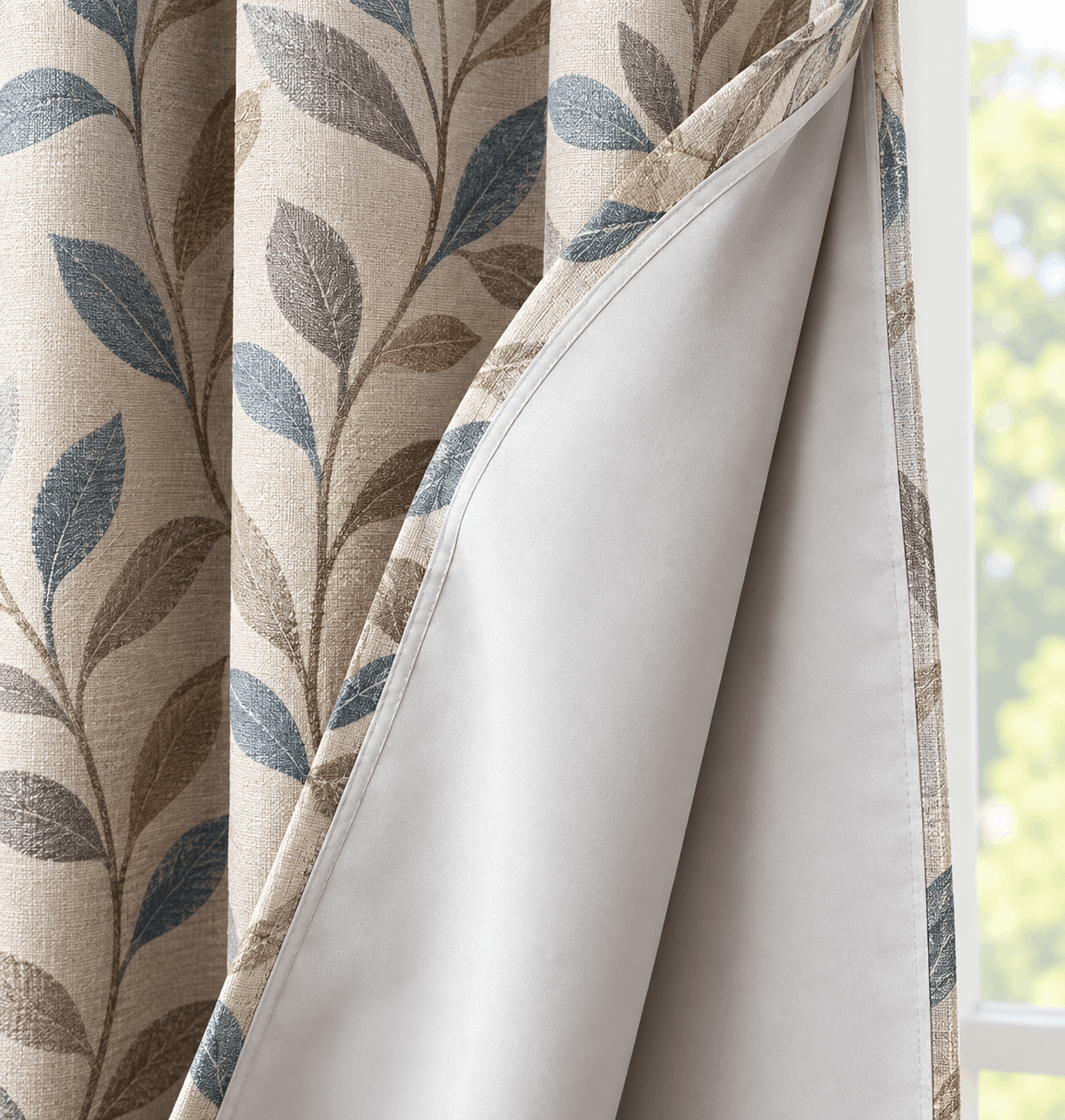
More Lining Does Not Always Mean a Better-Looking Curtain
This is something customers should understand before making their decision.
When you add an additional lining behind a decorative curtain, you are adding another layer.
That means the curtain becomes:
Heavier + thicker + more substantial.
This can change the way the curtain falls.
For a long curtain—particularly one extending 8 or 9 feet or more—the difference can become noticeable.
The customer may want beautifully flowing, soft folds.
But adding a heavier lining can make the overall curtain stiffer and heavier, which may affect the softness of the folds.
This is especially important when selecting a curtain with a flowing Ripple / Wave Fold appearance.
The objective is therefore not simply to add as much lining as possible.
The objective is to select the right combination of fabric, lining and curtain construction for the desired result.
The Choice Is Often About Performance vs Appearance
This is one of the most important things to understand before buying curtains.
You may want:
Maximum Light Control
Then blackout may be the priority.
Better Protection for Your Decorative Fabric
Then a suitable lining may be important.
Beautiful, Soft Curtain Folds
A lighter construction may produce the drape you prefer.
Privacy Without Complete Darkness
A thick decorative curtain or dimout may be sufficient.
Daylight During the Day + Privacy at Night
A combination of sheer and another curtain layer may provide greater flexibility.
There isn’t one curtain that is automatically best for every room.
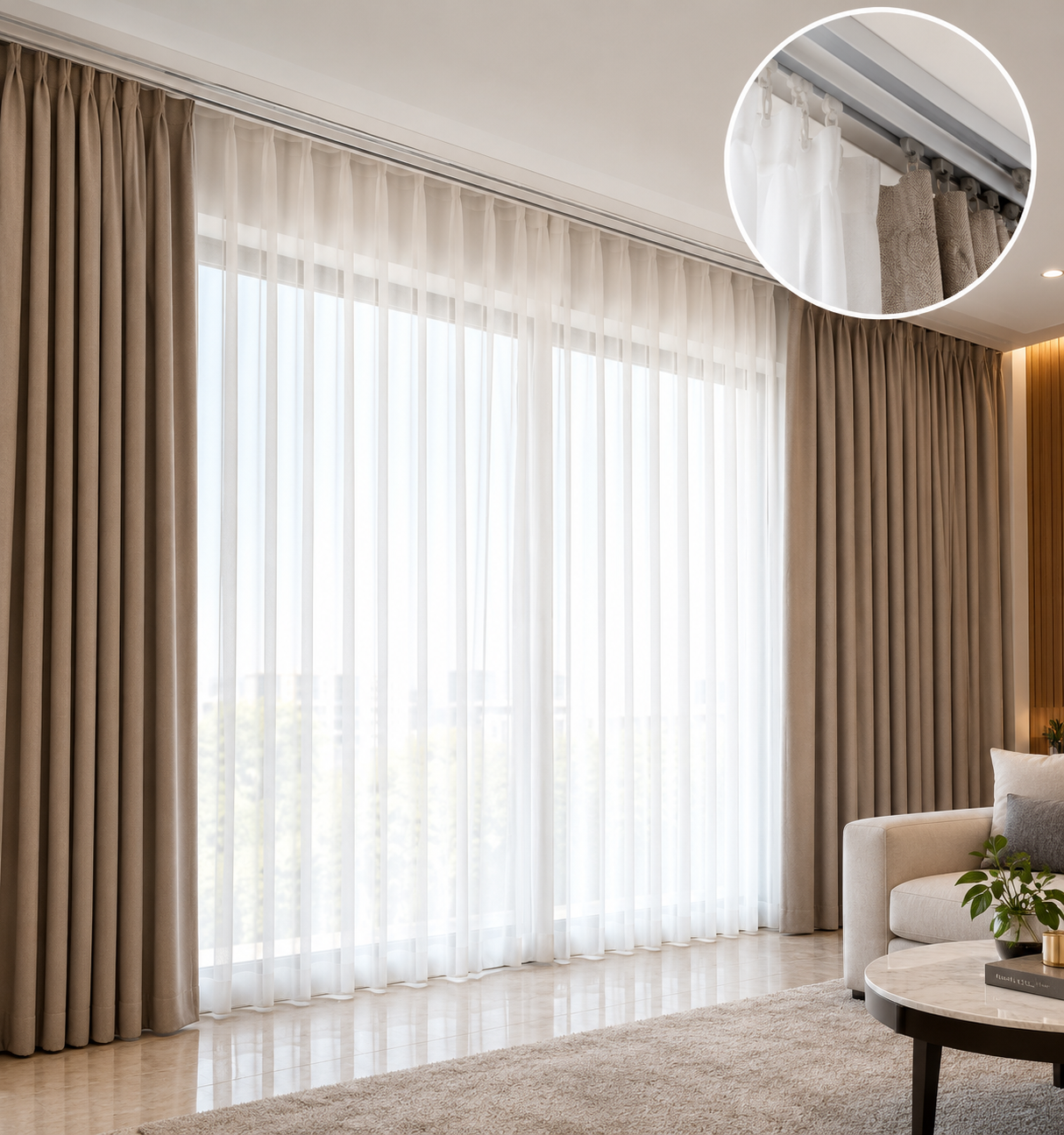
Why Layered Curtains Are So Popular
This is one reason layered window treatments have become increasingly popular.
Instead of asking one curtain to do everything, you can use two layers.
For example:
Sheer + Thick/Dimout/Blackout
During the day:
Sheer closed → Soft daylight + privacy
In the evening:
Outer curtain closed → Greater privacy + light control
This gives the homeowner much greater control over the room.
With an appropriate double-track system, the two curtain layers can operate independently.
And where convenience is important, the system can also be motorised.
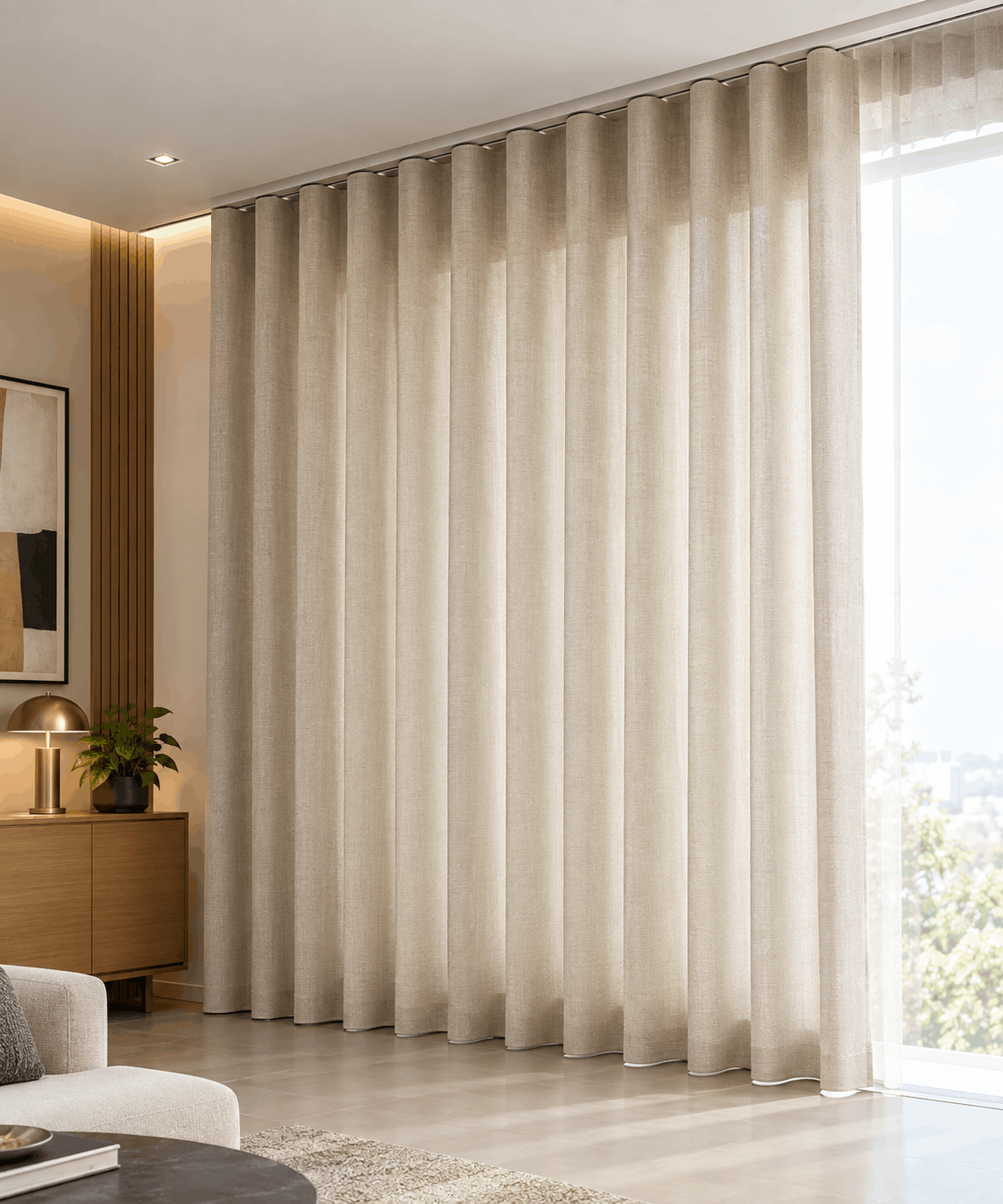
Ripple / Wave Fold and Lining
Ripple or Wave Fold curtains are known for their continuous, evenly spaced wave appearance.
They are particularly suited to modern interiors and ceiling-mounted track systems.
However, when choosing the fabric and any lining behind it, the overall construction needs to be considered.
A heavier combination can influence:
· The weight of the curtain
· The way it falls
· The way it stacks
· The softness of the waves
· The overall appearance
This is why the fabric, lining and track should be considered as one complete curtain system rather than as separate products.
Which One Should You Choose?
| If your priority is… | Consider |
|---|---|
| Natural daylight | Sheer |
| Soft, elegant appearance | Sheer / Thick Decorative |
| Good privacy | Thick Decorative / Dimout |
| Around 70% light reduction | Thick Decorative |
| Around 80% light reduction | Dimout |
| Maximum light blocking | Blackout |
| Protecting decorative fabric | Suitable lining |
| Flexible day/night control | Layered curtains |
| Modern wave appearance | Ripple/Wave Fold + suitable track |
| Convenient operation | Motorised track |
The Most Important Question to Ask Yourself
Before selecting your curtain, don’t simply ask:
“Which curtain is the best?”
Ask:
“What do I want my curtain to do?”
Do you want:
Light?
Privacy?
Heat protection?
Darkness?
A beautiful flowing appearance?
Protection for your fabric?
Or a combination of these?
Once you know the priority, choosing the right fabric becomes much easier.
Common Mistakes Customers Make
Mistake 1: Calling Every Thick Curtain "Blackout"
Thickness does not automatically mean blackout.
Mistake 2: Choosing Blackout Because It Sounds Better
If you don’t actually need complete darkness, a thick decorative curtain or dimout may provide the balance you prefer.
Mistake 3: Adding Heavy Lining Without Considering the Drape
More protection can also mean more weight.
Mistake 4: Choosing Fabric Without Considering the Curtain Style
A fabric that looks beautiful in a sample may behave differently when made into a long curtain.
Mistake 5: Treating Fabric and Track as Separate Decisions
The curtain and its track should work together.
Mistake 6: Expecting a Blackout Curtain to Eliminate Every Ray of Light
Even when the fabric itself blocks light completely, light can enter around the edges depending on the installation.
Zed's Expert Insight
Don’t buy a curtain simply because it is called “blackout.”
First decide what you actually want from the window:
Privacy? Light reduction? Heat protection? Fabric protection? Complete darkness? Or a beautiful flowing curtain?
Sometimes the best solution is a thick decorative curtain.
Sometimes it is dimout.
Sometimes blackout is the right choice.
And sometimes the best answer is two layers working together.
The right curtain is not the one with the biggest claim on the label.
It is the one that gives you the right balance between performance and appearance for your room.
Final Thoughts
The words sheer, thick, dimout and blackout describe very different curtain solutions.
A sheer curtain brings softness and daylight.
A thick decorative curtain provides privacy and significant light reduction while offering beautiful fabric choices.
Dimout provides a higher level of light control.
Blackout is designed for maximum light blocking through the fabric.
And lining can add another layer of protection and performance—but it can also change the weight and drape of the finished curtain.
Understanding these differences before you buy can help you make a much better decision.
At Zed’s, we believe customers should understand what they are buying and why they are buying it.
Because a curtain is not simply a piece of fabric hanging over a window.
It is a complete combination of fabric, construction, lining, track, installation and design.
Choose each element carefully, and the result will be a window treatment that not only looks beautiful but works exactly the way you want it to.
Frequently Asked Questions
What type of curtains are best for a living room?
No. A thick decorative curtain can provide substantial privacy and light reduction without being a true blackout fabric.
What is the difference between dimout and blackout curtains?
Dimout is designed to significantly reduce incoming light, while blackout is designed for maximum light blocking through the fabric. In Zed’s practical classification, dimout is around 80% while blackout is around 100%.
What is a normal thick curtain?
A thick decorative curtain is a substantial curtain fabric that provides privacy, reduces sunlight and adds to the interior design. It is not necessarily engineered as a blackout fabric.
Are sheer curtains completely private?
No. Sheer curtains allow light through and provide a degree of daytime privacy depending on the fabric and lighting conditions. They should not be considered a complete privacy solution at night.
Does blackout mean the room will be completely dark?
Not necessarily. Blackout fabric is designed to block light through the fabric, but light can still enter around the edges depending on the window and installation.
Does curtain lining protect fabric from sunlight?
Yes. Suitable lining can help protect the decorative face fabric from sunlight and can also add body and improve other performance characteristics.
Does blackout lining affect curtain drape?
It can. Adding another layer increases the weight and thickness of the curtain, which can influence how the finished curtain falls and forms its folds.
Should I choose blackout or dimout curtains?
It depends on your requirements. If maximum darkness is important, blackout is the more appropriate choice. If you want significant light reduction while retaining more flexibility in fabric appearance and drape, dimout may be suitable.
Can I combine sheer and blackout curtains?
Yes. A layered curtain system can provide soft daylight and privacy during the day and greater light control when the outer curtain is closed.
Explore Zed's Curtains
Explore the Zed’s collection of curtain fabrics, sheers, blackout and dimout options, custom curtain solutions and professional installation.